
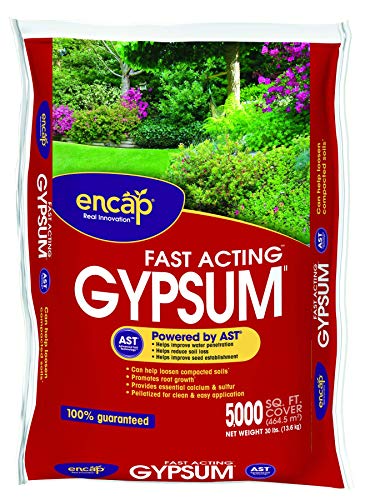
Encap Fast Acting Gypsum
A recognizable 30-pound gypsum option, with a purchase condition: obtain its current directions before deciding the amount to use. Heavy clay alone does not establish that gypsum will solve the lawn’s drainage problem.
- A good fit for
- A buyer whose soil guidance calls for gypsum and who can confirm the current 30-pound ENCAP package directions before application.
- The tradeoff
- The manufacturer’s current Earth Science gypsum page describes a different 25-pound product. Its rate and performance claims cannot be transferred to this older ENCAP 30-pound identity.
We may earn a commission from purchases through our links. How this works
Buy on AmazonProduct profile · Updated
Identify the red 30-pound ENCAP package
The current retail identity and photograph show ENCAP Fast Acting Gypsum in a red 30-pound bag. The front lists 5,000 square feet of coverage and AST branding. These details are enough to distinguish the linked product from a generic gypsum listing, but the front is not a complete set of use directions.
A current manufacturer page for Earth Science Fast Acting Gypsum describes a 25-pound bag and different branded technology. The similar purpose and product name do not establish equivalent formulation or application instructions. This profile keeps that newer package separate rather than silently replacing the ENCAP product behind the existing link.
Before ordering, request a readable image of the actual 30-pound bag’s back label. Confirm the net weight, product name, directions and any handling notices together. The retail identity supports which package is linked; it does not independently verify the advertised speed or effectiveness of a soil treatment.[1][5]
Decide whether gypsum matches the soil problem
- Calcium or sulfur need
- Gypsum supplies calcium and sulfur; evaluate that purpose using soil guidance.[3]
- Low soil pH
- Gypsum does not raise pH like agricultural lime, so it is not an interchangeable acidity treatment.[3]
- Poorly draining clay
- Gypsum is not a universal clay fix; the extension discussion ties drainage improvement to sodic soils.[3]
Read where gypsum can and cannot help
Gypsum is calcium sulfate. Oregon State Extension explains that it can supply calcium and sulfur without raising soil pH as agricultural lime does. That distinction is useful when calcium is wanted but a pH increase is not. It also means gypsum is not a substitute for lime when the purpose is correcting acidity.
The same extension article gives an important limit to clay-loosening claims: gypsum’s drainage benefit is associated with sodic, high-sodium soils. The article discusses Columbia County, Oregon, where ordinary acidic clay does not make gypsum a quick drainage fix. Its regional example should not be read as a soil diagnosis for a lawn elsewhere.
For a compacted or persistently wet lawn, establish what is causing the problem before buying a large bag. The decision depends on soil conditions, not simply the word clay. A product name containing fast acting does not show how quickly a particular lawn will recover or establish that gypsum is the needed intervention.[3][1]
Treat front coverage as a planning clue
Thirty pounds divided across 5,000 square feet works out to six pounds of product per 1,000 square feet. That is a calculation from the photographed front panel, not a verified application instruction for a particular soil condition. It does not establish how often to repeat the treatment or whether the same rate applies to every intended use.
The distinction matters because the exact current 30-pound ENCAP back label was not recovered during this review. The Earth Science 25-pound page gives its own directions, and Espoma’s separate gypsum product uses a substantially different lawn rate. Neither supplies missing directions for this bag.
Use the front coverage to recognize the package, then obtain the current label before calculating an order. A soil-specific recommendation may require additional interpretation from a local extension service or agronomist. Avoid turning an easy division into an unsupported prescription.[1][5][4][3]
Separate salt concerns from a guaranteed repair claim
Oregon State’s discussion makes sodium status relevant to gypsum use, but it does not establish that every brown strip beside a salted driveway requires this product. Nor does a verified front photograph demonstrate repair of pet damage, a particular improvement in water retention or a faster recovery than another brand.
For this package, the useful next information is a current label and soil guidance that explains the intended correction. If the problem remains unidentified, buying on a broad claim about clay or salt risks choosing a treatment without knowing whether its mechanism addresses the site.
This narrower details page therefore identifies the product and explains the soil decision without inventing a watering schedule, repeat interval or spreader setting. Those practical directions belong to the actual package. Their absence is a reason to obtain more information before use, not a reason to import instructions from a similarly named product.[1][3][5]
Compare Espoma when accessible directions matter
Espoma Garden Gypsum is a useful comparison because its current manufacturer page provides explicit lawn directions for its 36-pound format. The listed lawn rate is 36 pounds per 1,000 square feet, with watering after application. Its different package and rate should be assessed on their own terms.
That makes Espoma easier to evaluate from current public directions; it does not demonstrate that it works better or that the two products are equivalent pound for pound. Apply the same soil-fit question to both. A clear rate does not make gypsum appropriate for ordinary clay merely because it drains poorly.
If the need itself is uncertain, a soil-testing service is another useful first step. MySoil’s manufacturer describes nutrient and pH analysis with online recommendations. Obtain appropriate interpretation for a suspected sodium or drainage problem rather than assuming a basic result is a complete remediation plan.[4][3][2]
When to choose something else
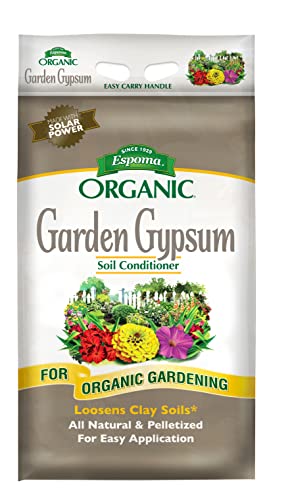
Espoma Organic Garden Gypsum
For a gypsum product with current manufacturer lawn directions publicly available. Its 36-pound package uses its own rate; that is not proof of superior performance or equivalence to ENCAP.
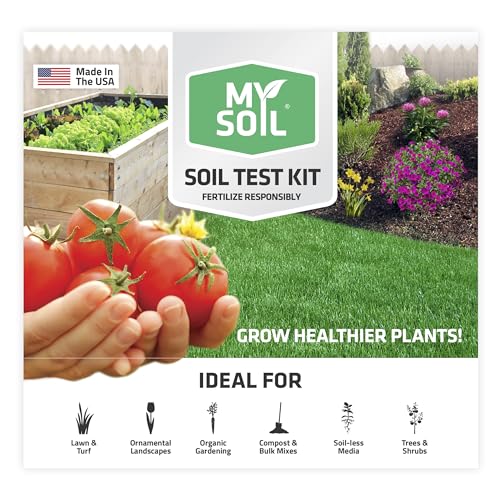
MySoil Soil Test Kit
For nutrient and pH information before choosing an amendment; seek suitable interpretation when sodium or drainage is the concern.
Sources & research notes
This profile draws on published product information and relevant care or operating guidance. We have not conducted a hands-on trial of this product. General guidance explains the intended task; it does not establish this product’s performance.
Amazon: current product identity and package photograph
Commerce identity only; not evidence of product performance.
Buy on AmazonRead 2026-09-23
- MySoil: mail-in laboratory soil test kit
Read 2026-09-23
- Oregon State Extension: Gypsum, soil drainage, and Columbia County gardens (January 2020, page 3)
Read 2026-09-23
- Manufacturer: current espoma product information
Read 2026-09-23
- Manufacturer: current earth-gypsum product information
Read 2026-09-23
Check the product before ordering
Check the package size, formulation and current label directions.