
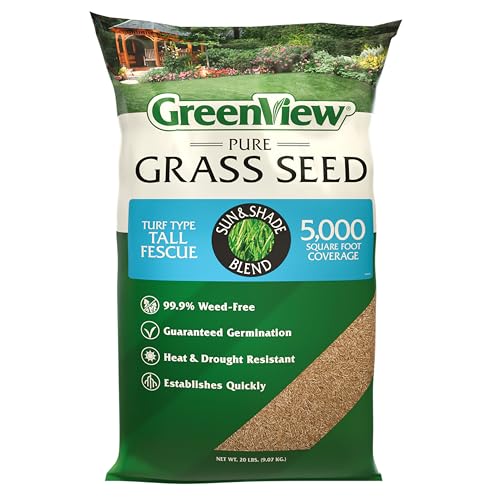
GreenView Pure Grass Seed Turf Type Tall Fescue
Consider this uncoated blend for a locally suitable tall-fescue lawn when you want straightforward seed coverage and can maintain it through summer stress.
- A good fit for
- New lawns, bare spots and overseeding where turf-type tall fescue suits the climate and available light.
- The tradeoff
- Tall fescue has limited spreading repair. Plan to diagnose and reseed damaged areas, and do not treat disease-resistance claims as immunity.
We may earn a commission from purchases through our links. How this works
Buy on AmazonResearch-based review · Updated
Tall-fescue blend and Sun & Shade Mixture are different products
GreenView describes this product as a blend of tall-fescue varieties. Its packaging comparison lists Turf Type Tall Fescue Sun & Shade Blend separately from Sun & Shade Mixture. Those similar names matter: a formula taken from the multi-species mixture does not describe this tall-fescue product, and a shared garden photograph is not enough to identify a bag.
The current linked bag is twenty pounds. GreenView also publishes directions for three- and seven-pound versions, so check the weight as well as the product name when ordering. For the twenty-pound tall-fescue blend, its stated new-lawn coverage is 2,500 square feet and its overseeding coverage is 5,000. The ryegrass product in the same range has different figures.
We do not have a current-lot seed analysis establishing the cultivar names or their proportions. Read that analysis on the delivered package instead of relying on percentages attributed to another GreenView mixture. The supported buying distinction is an uncoated tall-fescue blend; it is not a verified five-species recipe or a guarantee of a particular named cultivar.[3][4][2]
Uncoated seed makes one comparison simpler
GreenView says the Pure Grass Seed range has no coatings or fillers. That is useful when you want the seed format without a combined fertilizer or water-retaining coating, and it makes the manufacturer's coverage straightforward to apply. It does not make the product inherently superior to every coated alternative.
Pure seed branding is not a laboratory finding of one hundred percent purity or germination. The analysis label still matters: check purity, germination, weed and other-crop seed, inert material and test information. The manufacturer also advertises a virtually weed-free product, but that claim does not mean weeds already in your soil cannot emerge after preparation and watering.
For value, compare the cost of the amount needed for your actual area, then consider the grasses and lot quality. Price per pound alone is a poor shortcut when comparing an uncoated blend with a coated product. We have not established a current price advantage or a trial result showing that GreenView outperforms competing retail bags. The practical advantage here is a clearly described seed format, not a brand-based ranking.[3][4][2]
Choose tall fescue for the site, not the package promise
- Establishment
- Young roots need consistent moisture; mature-lawn drought claims do not replace seedling watering.[3][4]
- Bare patches
- Tall fescue has limited spreading repair, so substantial damage may require more seed.[6]
- Summer care
- Heat, humidity and brown patch remain considerations; use regional maintenance guidance.[7]
Read the tall-fescue fit and limits
The manufacturer describes a sun-and-shade tall-fescue blend with heat and drought resistance after a healthy root system develops. That is a plausible reason to investigate the product for an appropriate cool-season or transition-region lawn. It is not a claim that seedlings can be left dry or that every deeply shaded location can support dense turf.
Independent species guidance supplies the necessary limits. Colorado State describes tall fescue as a bunch-type grass with limited ability to fill damaged areas. NC State discusses warm-weather brown patch and seasonal maintenance, including a higher summer mowing height. These are reasons to plan for care and repair, rather than treating the bag's stress-resistance language as a maintenance exemption.
Before overseeding, identify what is growing now and why it thinned. If the underlying problem is recurring traffic, poor preparation or unsuitable growing conditions, more seed alone may not solve it. Choose the grass with local climate guidance, and assess the actual patch of lawn rather than assuming one product will fit every part of the yard.[3][6][7][1]
A twenty-pound bag covers 2,500 or 5,000 square feet
- 20 lb, new lawn
- 2,500 sq ft, including bare-spot establishment.[3]
- 20 lb, overseeding
- 5,000 sq ft where suitable turf already exists.[3]
- 2,000 sq ft project
- 16 lb new lawn or 8 lb overseeding.[3]
Read the quantity calculation
GreenView publishes 2,500 square feet for a new lawn or bare spots and 5,000 square feet for overseeding from its twenty-pound bag. That works out to eight pounds per 1,000 square feet for new lawn and four pounds for overseeding. Use the heavier application where grass is absent, instead of stretching the bag to the largest printed coverage figure.
For a 2,000-square-foot project, plan on sixteen pounds for new lawn or eight pounds for overseeding. If the area combines bare ground with thin existing grass, measure the portions separately. A seven-pound bag is rated for 875 square feet of new lawn or 1,750 square feet of overseeding, so it will not cover the entire example at either published rate.
These are manufacturer coverage calculations, not a pure-live-seed calculation from a particular lot. Verify the actual bag before applying and adjust the spreader for that product. The package warns against crowding too much seed into one area. Extra seed on hand can be useful for later repairs, but putting it all down at once does not guarantee a thicker lawn.[3][4][2]
Prepare the soil and leave time for establishment
The manufacturer gives ten to fourteen days for germination, while its package comparison lists establishment thirty to forty-five days after germination. Those are separate stages. A few green shoots do not establish that the entire area is rooted well enough for routine traffic, and weather can move the schedule in either direction.
For a new lawn or bare repair, the package calls for loosening the top two to three inches of soil, removing debris and breaking up large clods. That preparation depth is not the depth at which to bury the seed. After spreading evenly, lightly rake so no more than one-quarter inch of soil covers the seed. Prepare thin existing areas for soil contact as well.
Keep the seedbed moist with light watering without saturating it. GreenView says to continue at least daily until new grass reaches two inches, then keep the developing roots moist. Use local planting windows and the actual soil conditions to schedule the project. Check treatment-label restrictions before any herbicide use around seeding; the seed package cannot override the label of another product.[3][4][1][7]
Maintain the stand and compare the planting format
GreenView's package says to begin mowing when the new grass reaches three inches and to maintain that height with a sharp blade. Regional guidance can refine the ongoing setting: NC State recommends three and a half inches during summer. Use advice for your location and season rather than applying one package number unchanged throughout the year.
Base fertility decisions on soil information and local recommendations. Monitor thinning before deciding that annual reseeding is inevitable or that a different brand will fix it. Tall fescue's limited spreading means damaged areas can need help, but the cause and extent of damage determine the work. A maintained stand and a newly seeded patch have different watering needs.
Outsidepride Combat Extreme Transition Zone offers a useful comparison if you want a coated tall-fescue blend. Its current product includes OptiGrowth and has its own application directions, so compare the required quantity as well as the format. Neither the presence nor absence of coating proves a performance winner. Choose based on suitable grass, a credible lot analysis and a planting plan you can carry out.[4][7][6][5]
When to choose something else

Outsidepride Combat Extreme Transition Zone
Compare Combat Extreme Transition Zone for a coated tall-fescue blend. OptiGrowth changes the supplied planting format; use that product’s rates and lot analysis rather than assuming equal pounds are interchangeable.
Sources & research notes
This review draws on published product information and grass-selection guidance. We have not conducted a hands-on trial of this product. Species guidance helps explain the choice; it is not a trial of the bag you buy.
- University of Minnesota Extension: renovating a lawn
Read 2026-09-23
- UMass Extension: understanding the turfgrass seed label
Read 2026-09-23
- GreenView: Pure Grass Seed Turf Type Tall Fescue product and coverage
Read 2026-09-23
- GreenView: Pure Grass Seed package directions and variety comparison
Read 2026-09-23
- Outsidepride: Combat Extreme Transition Zone product and planting guide
Read 2026-09-23
- Colorado State University Extension: turfgrass species selection
Read 2026-09-23
- NC State Extension: Tall fescue lawn maintenance calendar
Read 2026-09-23
Ready to compare the bag?
Check the package size and seed tag before ordering.