
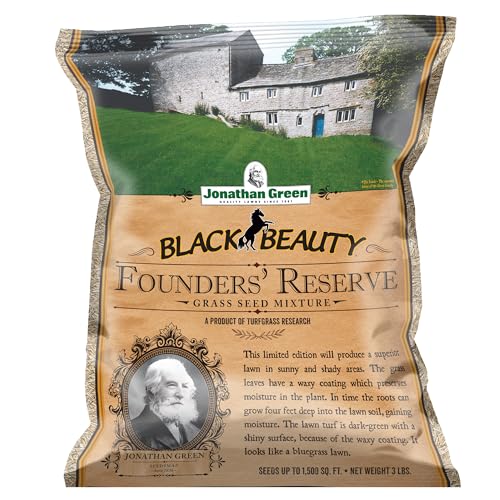
Jonathan Green Black Beauty Founders' Reserve
Consider Founders Reserve if its tall-fescue-and-hybrid-bluegrass combination fits your lawn and you can support a cool-season establishment plan.
- A good fit for
- The manufacturer’s intended use is a sunny-to-partly-shaded cool-season lawn, with at least six hours of sunlight specified.
- The tradeoff
- Premium positioning and deep-root claims do not prove better results than another blend or eliminate summer care.
We may earn a commission from purchases through our links. How this works
Buy on AmazonResearch-based review · Updated
Look past the limited-edition presentation to the grass types
Founders Reserve is presented as a premium, limited-edition mixture associated with professional sod growers. The useful technical detail is its stated combination of Soft Blade and Soft Touch tall fescues with Solar Kentucky–Texas hybrid bluegrass. That description provides a starting point for comparison; it does not turn the product into an all-bluegrass lawn.
The tall-fescue and hybrid-bluegrass components make this a cool-season mixture. Assess that grass choice against the climate and your maintenance plans before deciding whether the packaging or brand story is persuasive. A lawn that needs a different grass type will not become a good fit just because the seed is marketed as an advanced selection.
The product page describes sunny and shady uses but separately specifies at least six hours of sunlight each day. Treat that specification as the useful limit. For an area under persistent deep shade, the broad sun-and-shade language is not enough to justify the purchase. We have not conducted a lawn trial or verified a current lot's composition percentages.[7][3][2]
Understand what the root and leaf claims establish
- Four-foot roots
- The manufacturer describes potential depth over time; your lawn’s root depth is not verified.[8]
Read the claim boundaries
The manufacturer describes dark-green leaves with a waxy surface that preserves moisture, and roots that can grow four feet deep. Its package uses conditional language about roots reaching that depth over time. Those claims describe the intended plant characteristics, not a measurement of the root system that will develop in every yard.
Leaf wax should also be distinguished from a coating applied to seed. The presence of a waxy-leaf claim does not prove that this package has a particular seed treatment, fertilizer coating or amount of inert material. The analysis tag and actual bag directions answer different questions from a description of mature leaves.
Colorado State's hybrid-bluegrass guidance emphasizes that research and field observations are limited and responses differ among cultivars. It is useful context for evaluating hybrid claims, but it is not an independent test of Founders Reserve or Solar in this retail mixture. No fixed irrigation saving, disease immunity or guaranteed root depth is established by this review.[7][8][2][3]
Calculate the three-pound quantity before comparing prices
- 3 lb, new lawn
- Up to 750 sq ft in the manufacturer’s size table.[7]
- 3 lb, overseeding
- Up to 1,500 sq ft in the manufacturer’s size table.[7]
- 1,000 sq ft project
- 4 lb new lawn (3 × 1,000 ÷ 750) or 2 lb overseeding (3 × 1,000 ÷ 1,500).[7]
Read the quantity and package distinction
The primary purchase link is the three-pound Founders Reserve package. The manufacturer's size table gives up to 750 square feet for a new lawn or 1,500 square feet for overseeding. That translates to four pounds per 1,000 square feet of new lawn and two pounds for overseeding.
A 1,000-square-foot bare project therefore needs four pounds at the stated rate, more than one three-pound bag. A thin existing stand over the same area uses two pounds by the manufacturer's coverage calculation. Treat bare and thin portions separately rather than using the larger overseeding figure for the whole project.
The linked downloadable manufacturer artwork describes a seven-pound package, with 1,750 square feet new and 3,500 overseeding. Those figures are consistent per pound, but the package weight is different. Use the current three-pound size table for buying and check the actual bag before application. Compare the cost of the total quantity needed, without assuming limited-edition branding by itself demonstrates a better value or a better result.[7][8]
Let soil information guide preparation
The Founders Reserve package places considerable emphasis on soil improvement and promotes several companion products. The practical starting point is a soil test and a diagnosis of why the lawn needs renovation. Minnesota Extension recommends understanding the cause of decline before adding new seed, because changes in care or site conditions may be necessary too.
Do not automatically add lime, acidifying products or every recommended amendment as a standard seeding bundle. Use the soil results and the relevant product labels to decide what is needed. A seed package's cross-promotion does not establish that all lawns have the same pH or nutrient problem.
Create seed-to-soil contact by removing debris and preparing the surface. The package says to rake the seed in lightly and not bury it deeper than a quarter-inch. If the area is compacted or repeatedly worn bare, address that as part of the project. Buying a premium mixture while leaving the underlying problem unchanged can turn an avoidable repair into a recurring purchase.[8][1][5]
Separate first shoots from an established lawn
Jonathan Green estimates fourteen to twenty-one days for germination. Its package notes that spring plantings may take longer and says soil temperature should be consistently 55°F. Choose an appropriate local cool-season planting window and allow time for establishment, rather than treating a germination estimate as the date the lawn is finished.
Keep the seedbed moist during germination, using the soil and weather to judge watering needs. As the seedlings develop, the watering approach changes. A fixed number of sprinkler minutes is not a guarantee of the right moisture in every soil. Check any previous weed-control application's actual reseeding restrictions before starting.
The downloadable label gives a first-mowing height of two-and-a-half to three inches; the current webpage says three to four inches. Follow the actual package and local guidance as the stand develops. Avoid scalping or removing more than a third of the leaf in one cut. The first mowing is another establishment milestone, not evidence that the lawn can handle unlimited traffic.[7][8][1][5]
Compare a different composition, not just a premium name
Turf Saver RTF is a useful alternative if you want a tall-fescue blend without a bluegrass component. Its manufacturer describes conventional and rhizomatous tall fescues, with separate seeding rates and establishment guidance. Founders Reserve instead combines tall fescues with hybrid bluegrass. That composition difference is more useful than treating either brand's premium language as a ranking.
We have not established a current-bag performance winner between them. Nor should general research about one cultivar, grass species or recovery mechanism be treated as a direct trial of either retail mixture. Compare the actual seed analysis, local suitability and quantity required for the project.
After establishment, plan for seasonal care. NC State's tall-fescue guidance discusses summer stress and brown patch; the existence of a hybrid component does not prove those concerns disappear. Founders Reserve is worth considering when its stated grass combination fits your lawn goals, but the seed still needs a suitable site and realistic maintenance expectations.[6][7][3][4][2]
When to choose something else
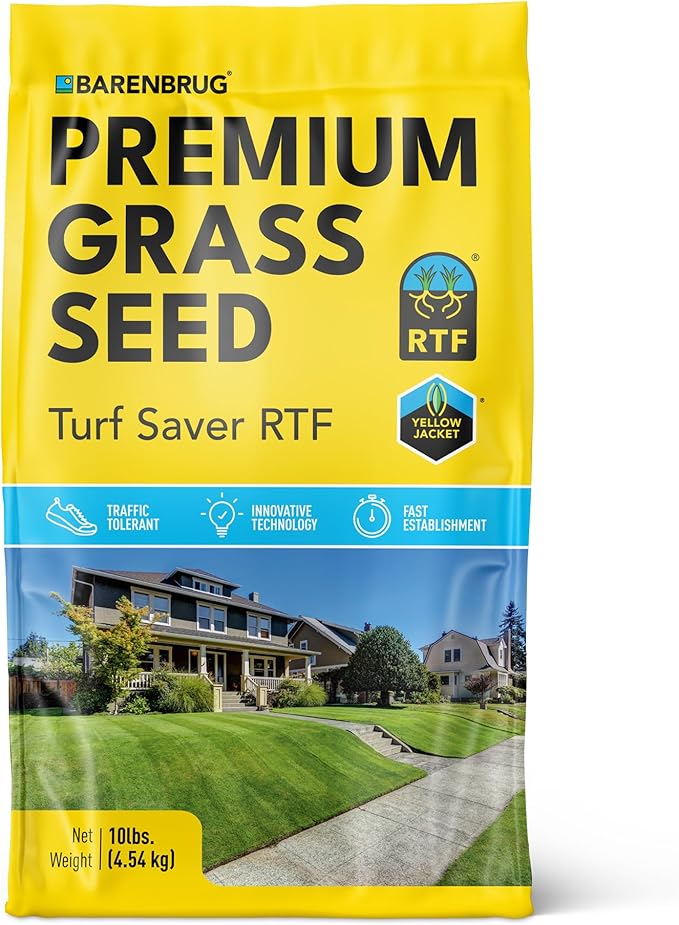
Barenbrug Turf Saver RTF
Compare Turf Saver RTF for a conventional-and-rhizomatous tall-fescue blend without Founders Reserve’s hybrid-bluegrass component. The formulas and rates differ, and no direct performance winner is established here.
Sources & research notes
This review draws on published product information and grass-selection guidance. We have not conducted a hands-on trial of this product. Species guidance helps explain the choice; it is not a trial of the bag you buy.
- University of Minnesota Extension: renovating a lawn
Read 2026-09-23
- UMass Extension: understanding the turfgrass seed label
Read 2026-09-23
- Colorado State University Extension: hybrid Kentucky × Texas bluegrasses for Colorado
Read 2026-09-23
- NC State Extension: Tall fescue lawn maintenance calendar
Read 2026-09-23
- University of Minnesota Turfgrass Science: Does your lawn struggle?
Read 2026-09-23
- Barenbrug: Turf Saver RTF technical sheet B010726 (2026)
Read 2026-09-23
- Jonathan Green: Black Beauty Founders Reserve product and planting guide
Read 2026-09-23
- Jonathan Green: Founders Reserve seven-pound package artwork
Read 2026-09-23
Ready to compare the bag?
Check the package size and seed tag before ordering.