

Jonathan Green Black Beauty Heavy Traffic Grass Seed
Consider Heavy Traffic for a suitable cool-season lawn with enough light and a plan to manage repeated wear.
- A good fit for
- Used backyards and similar areas where a tall-fescue-and-ryegrass mixture fits the climate and receives at least six hours of sunlight.
- The tradeoff
- Wear tolerance is not unlimited recovery: concentrated traffic can compact soil and overwhelm even an appropriate grass choice.
We may earn a commission from purchases through our links. How this works
Buy on AmazonResearch-based review · Updated
Choose for the grass mixture, not the sports-field promise
Jonathan Green markets Heavy Traffic for backyards, curb strips and athletic areas. The current species description is a mixture of tall fescues and perennial ryegrass. That makes it a cool-season planting choice, not a universal seed for every climate or a substitute for managing a frequently used lawn.
The manufacturer specifies at least six hours of sunlight daily, even though its broader description also mentions partial shade. Use that numerical requirement when deciding whether the planting area is a reasonable match. A shady, compacted shortcut can combine several stresses that a durable-seed claim does not resolve.
The 2026 catalog names several cultivars, but also says mixtures can change. We have not verified a current-lot analysis or run a wear trial on this bag. Treat the brand's claims about deep roots, disease resistance and athletic performance as manufacturer claims rather than independent results. The practical question is whether the grass types and management demands fit your yard, not whether the front label sounds more rugged than another blend.[4][6][3][2]
Repeated traffic needs a site plan as well as seed
- Wear on plants
- A tougher mixture still has limits under repeated concentrated use.[3]
- Compacted soil
- Reduced pore space makes root growth and recovery harder.[3]
- The repair plan
- Consider dispersing traffic and addressing compaction alongside reseeding.[3]
Read the wear and repair limits
Foot traffic damages plants and can compact the underlying soil. University of Minnesota turf guidance explains that compaction reduces pore space and limits air and water movement, making recovery more difficult. Even a grass species with useful traffic tolerance has limits when wear is concentrated in the same place.
Before reseeding, identify where people or pets repeatedly cross the lawn. Dispersing that use and relieving compaction may be part of a successful repair. A permanent path may make more sense for a route that is continually worn bare. Adding seed without changing the cause can leave you paying for the same repair again.
Also distinguish an established lawn's ability to handle use from a seedling's readiness for it. Germination is not an opening date for regular play. Give the developing stand time to root and fill in, and judge its condition rather than relying on the word “traffic” in the product name. This review does not establish a guaranteed recovery rate or a number of daily passes the grass can withstand.[3][1][4]
Use the three-pound coverage for the linked package
- 3 lb, new lawn
- Up to 600 sq ft.[5]
- 3 lb, overseeding
- Up to 1,200 sq ft.[5]
- 1,000 sq ft project
- For 1,000 sq ft: 5 lb new lawn (3 × 1,000 ÷ 600), or 2.5 lb overseeding (3 × 1,000 ÷ 1,200), calculated from the three-pound label.[5]
Read the size-specific coverage
The three-pound manufacturer label lists up to 600 square feet for a new lawn and 1,200 square feet for overseeding. That is equivalent to five pounds per 1,000 square feet of new lawn or two-and-a-half pounds for overseeding. A bare repair needs the new-lawn quantity; the larger coverage assumes grass already exists.
For a 1,000-square-foot bare area, one three-pound bag is not enough at the stated rate. For a thin existing stand of suitable grass, the same size covers the area on paper, subject to the actual package directions. Measure the bare and thin portions separately if your project includes both.
The current webpage lists seven- and twenty-five-pound packages with different new-lawn coverage per pound. Do not silently scale those figures onto the three-pound bag. Its own downloadable label and size-specific webpage row agree on 600 square feet new and 1,200 overseeding. Compare the cost of the quantity you actually need, and calibrate application against the measured area rather than treating a spreader setting as an exact output on every machine.[4][5]
Keep germination estimates separate from readiness for use
The package and the main product description give ten to fourteen days for germination. A separate specification on the same webpage says seven to fourteen days. We use the package's longer estimate for planning while making the discrepancy visible; neither number promises complete coverage by that date.
The label notes that spring plantings may take longer. Plan around a suitable local cool-season planting window, with enough time to prepare the ground and support seedlings. The manufacturer's general fall and spring dates are not precise deadlines for every location. Its soil-temperature guidance starts at 55°F, so calendar timing alone is not the full decision.
Remove debris, establish seed-to-soil contact and rake seed in lightly. The label says not to bury it deeper than a quarter-inch. Check any recent weed-control product's actual reseeding interval before starting. A generic delay on a seed webpage does not replace the restrictions on the herbicide you used. Keep routine traffic away while the newly planted stand is developing.[4][5][1]
Water for establishment and mow without scalping
Jonathan Green emphasizes keeping the seedbed moist for several weeks. Its webpage suggests short watering sessions, but the useful objective is moisture at the planting surface without runoff or pooling. Adjust attention to the soil and weather rather than assuming a fixed number of minutes always delivers the right result.
As seedlings grow, transition away from the frequent light watering used at germination. Minnesota's lawn guidance warns that overwatering can produce weak turf and shallow roots, adding another stress to a heavily used area. The mature lawn's watering pattern and the newly seeded area's needs are different stages of the job.
The downloadable label gives a first-mowing height of two-and-a-half to three inches, while the current webpage says three to four inches. Check the actual bag and use regional maintenance guidance as the stand develops. Keep blades sharp and avoid scalping. Mowing very short can weaken plants and leave room for weeds, which works against the goal of a durable surface.[4][5][3]
Compare a tall-fescue blend if the grass choice changes
Turf Saver RTF is a relevant alternative when you want a tall-fescue blend rather than Heavy Traffic's tall-fescue-and-ryegrass mixture. Barenbrug describes conventional and rhizomatous tall fescues in that product. It has different planting rates and establishment guidance, so do not transfer this three-pound bag's coverage to it.
That comparison is about composition and the intended lawn, not a proven head-to-head winner. A manufacturer's spreading or recovery claim does not show that a blend will overcome repeated compaction or unsuitable growing conditions. No direct comparative field test of these current retail bags is established here.
For either option, pair the purchase with a workable plan: enough light, a prepared seedbed, appropriate moisture and a realistic approach to traffic. If the same small area repeatedly fails despite those changes, reconsider how it is used. Heavy Traffic is a candidate for a suitable lawn repair, not a guarantee that grass belongs in every heavily traveled space.[7][4][3][1]
When to choose something else
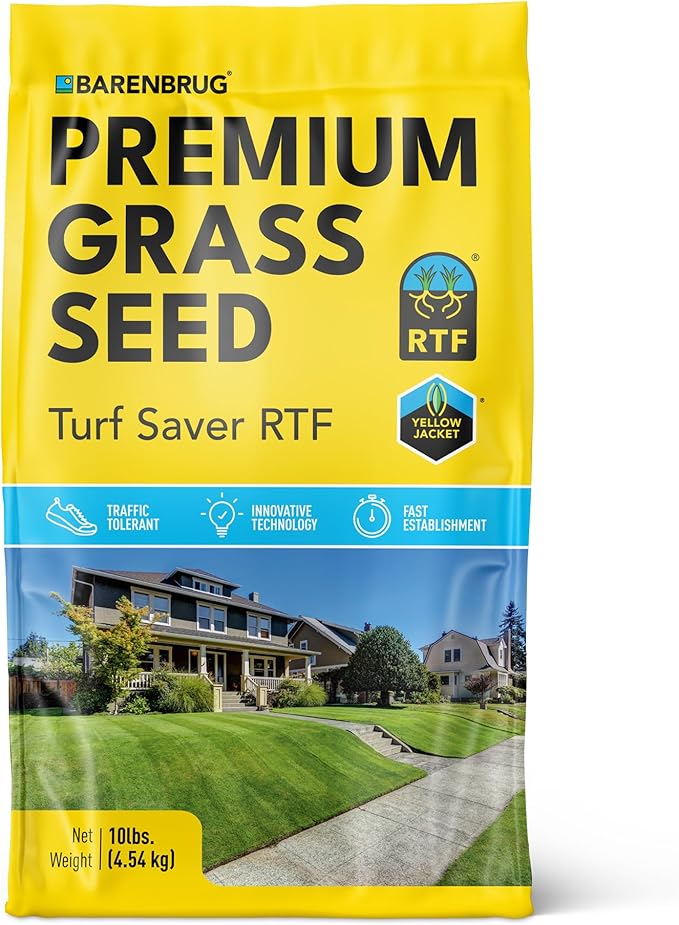
Barenbrug Turf Saver RTF
Compare Turf Saver RTF if you prefer a conventional-and-rhizomatous tall-fescue blend without Heavy Traffic’s ryegrass component. Use its own application and establishment guidance; no head-to-head performance winner is established here.
Sources & research notes
This review draws on published product information and grass-selection guidance. We have not conducted a hands-on trial of this product. Species guidance helps explain the choice; it is not a trial of the bag you buy.
- University of Minnesota Extension: renovating a lawn
Read 2026-09-23
- UMass Extension: understanding the turfgrass seed label
Read 2026-09-23
- University of Minnesota Turfgrass Science: Does your lawn struggle?
Read 2026-09-23
- Jonathan Green: Black Beauty Heavy Traffic product and planting guide
Read 2026-09-23
- Jonathan Green: Heavy Traffic three-pound package artwork
Read 2026-09-23
- Jonathan Green: 2026 retail catalog, page 19
Read 2026-09-23
- Barenbrug: Turf Saver RTF technical sheet B010726 (2026)
Read 2026-09-23
Ready to compare the bag?
Check the package size and seed tag before ordering.